Friday, March 14, 2014

Shopping smarter with Google Shopper

Were happy to announce a new Android application called Google Shopper. Shopper lets you find product information quickly by using your phones camera. It can recognize cover art of books, CDs, DVDs, and video games, along with most barcodes. You can also speak the name of the product youre looking for. Use Shopper to make smart decisions about what to buy, what price to pay, and where to buy it. You can star items for later and share them with friends. Shopper also saves your history so youll always have product and price information at your fingertips, even when you dont have a signal.

Heres an example search based on the Effective Java: Programming Language Guide.

To see Google Shopper in action, watch this video:


To download Google Shopper to your Android-powered phone, scan the QR Code below, or search for "Shopper" on Android Market. Youll see a green icon for Shopper by Google. Click install and happy shopping!


For more information about Google Shopper, take a look at our Google Labs page. We hope you send us your feedback.

Read More..

Thursday, March 13, 2014

App Engine 1 5 0 Release

The App Engine team has been working furiously in preparation for Google I/O time and today, we are excited to announce the release of App Engine 1.5.0, complete with a bunch of new features. This release brings a whole new dimension to App Engine Applications with the introduction of Backends, some big improvements to Task Queues, a completely new, experimental runtime for the Go language, High Replication Datastore as the new default configuration (and a lower price!), and even more tweaks and bug fixes.


Serving Changes


  • Backends: Until now all App Engine applications have been running on short-lived dynamic instances that we spin up and down in response to application requests. This is great for building scalable web applications, but has a number of limitations if you are looking to build larger, long-lived, and/or memory intensive infrastructure. With 1.5.0, we are introducing Backends which will allow developers to do precisely this! Backends are developer-controlled, long-running, addressable sets of instances which are as large as the developer specifies. There are no request deadlines, they can be started and stopped (or dynamically start when called), they can use between 128M and 1G of memory and proportional CPU. If you’d like to find out more, have a read through our Backend docs for Java and Python.

  • Pull Queues: Most of our users are heavily using Task Queues in their applications today, but there is lots of room for more flexibility. With 1.5.0 we are introducing Pull Queues to allow developers to “pull” tasks from a queue as applications are ready to process them, rather than relying on Task Queues to push tasks at a pre-configured rate. This means you can write a Backend to do some background processing and pull 1, 10, or 100s of tasks off the Pull Queue when the Backend is ready for more. In addition, we’ve introduced a REST API which will allow external services to do the same thing. For example, if you have an external server running to do image conversion or OCR, you can now use the REST API to pull tasks off, run them, and return the results. In conjunction with these 2 improvements, we’ve also increased the payload limits and processing rate. We are excited both about expanding the use of Task Queues as well as improving the ease of integration between App Engine and the rest of the cloud.

Datastore


  • High Replication Datastore as default: After months of usage and feedback on the High Replication datastore (as well as a record of 99.999% uptime so far) we are now confident that it is the right path forward for the majority of our users. So, today we are doing two things: setting HRD as the default for all new apps created, lowering the price of HRD storage from $0.45 down to $0.24, and encouraging everybody to begin plans to migrate. We really appreciate all the time that early users of HRD put into trying it out and finding issues and have fixed a number of those issues with this release.

Changed APIs


  • In response to popular demand, the HTTP request and response sizes have been increased to 32 MB.

  • Mail API: We have added a few restrictions to the Mail API to improve the reliability and reputation of the service for all applications. First, emails must be sent from email accounts managed by Google (either Gmail, or a domain signed up for Google Apps). Second, we’ve reduced the number of free recipients per day from 2000 to 100 for newly created applications. Both of these will help ensure mail from your application arrives at the destination reliably.

Administration


  • Code downloads: As of 1.5.0, we have expanded the ability to download an Application’s source code to include both the user who uploaded the code to download it as well as the Owner(s) of the project as listed in the Admin Console. Owners were introduced in 1.4.2 as an admin role.

Go


  • New runtime: With 1.5.0 we are launching an experimental runtime for the Go Programming Language. Go is an open source, statically typed, compiled language with a dynamic and lightweight feel. It’s also an interesting new option for App Engine because Go apps will be compiled to native code, making Go a good choice for more CPU-intensive tasks. As of today, the App Engine SDK for Go is available for download, and we will soon enable deployment of Go apps into the App Engine infrastructure. If you’re interested in starting early, sign up to be first through the door when we open it up to early testers. See the announcement on the Go Blog for more details.


There are plenty of additional changes and bug fixes in this release so please check out the full release notes, including all issues fixed for Java and Python. Finally if you are interested in where App Engine is heading later this year, check out our other announcement at I/O 2011!


The App Engine Team

Read More..

Wednesday, March 12, 2014

Googles new look for mobile

When it comes to mobile search, we strive to not only give you the same comprehensiveness and relevance as when searching with Google on your computer, but also a consistent look, feel, and overall user experience. So today, as we roll out a new look for Google Search results on your computer, we are happy to announce similar changes to Google Search results for mobile.

When you go to Google.com in the US on your iPhone or Android-powered device, and enter a search, you can now tap on the button to the left of the search box on the results page to see a new search options menu. Then, selecting any item in the menu will refine your search. For example, if you are looking for recent results for "Mothers day gift", simply tap the "Past week" option.


You may notice that when the menu expands, the search results slide off screen to the right. Note that you can still interact with them and see them in full just by panning to the right. Also, there are some additional menu options, like "News" and "Products". In the weeks to come, we will be supporting more devices and locales, and expanding the number of options available.

Update on 5/7 @ 9:20 am: Note that Palm webOS is now supported as well -- as some of you have noticed.

Read More..

Tuesday, March 11, 2014

Jolla GPS Navigation updated bug located

Update 2:  Navfree above version 2.1.14 doesnt get GPS connection.

Recommended not to update above this version (2.1.14), which seems to be the latest working one.

Update: Location data bug located - I call it a GPS Velocity Bug

User have been wondering why several Android Navigation Apps running on Jolla shows the car location at closeby roads and crossings, or shows you driving sideways / backwards. Ive been observing this behaviour the best I can, and by that Im pretty sure that there is a bug in the velocity data calculation, calculated from the gps data.

Jolla uses OpenSource code Geoclue, originally contributed by Garwin, for location data handling. This code should provide all the needed data very well, so the problem is within Qt or Sailfish code. My findings are based on observations only, so I can only share some possible options for the type of this bug. Either:
  •  Location is shown in the Navi app before the direction calculation is done. In this case, the Navi App would assume the direction sometimes as 0 (pointing to North)
  • Direction is calculated with inaccurate data. It should be calculated from the last two readings provided by gps, and if either of these readings is occasionally missing or old, the direction could show anything (e.g. making the Navi app to circle the map)
  • Direction data is not calculated at all. In this case the Navi app might show it as north all the time. 
In a modern smartphone there are three ways to determine the phone current direction: (1) Directly from the magnetometer data, (2) calculated from that and the accelerometer data, or (3) calculated from two data readings received from GPS. Navi apps are using this method.

Some Navi apps are able to use compass (Magnetometer sensor) as a supportive reading for the direction (e.g. when gps data is missing). Jollas compass should work fine, but its currently providing data to only some of the Android apps. (This is another known bug already under work. Im expecting it to be fixed after Qt 5.3. release). However, this is not related to the velocity bug.

We are also looking forward for a native Navi application for Jolla phones, but its not expected to be released yet in the next update. Im not expecting a fix to the velocity bug either unless its very small, as it was just discovered (well, I suppose some coders have noted this earlier)

Original article 12-Dec-2013

While waiting for updates to HERE Maps features, heres a simple HowTo for installing GPS Navigation to your Jolla smartphone. Voice navigation included, tested to work myself.

INSTALLING

  1. Register a Jolla account (needed to access Jolla store in the phone)
  2. Open Jolla store and install Android Support (close the store)
  3. Open your phone browser, go to address m.aptoide.com/installer.* Install Aptoide store (close browser)
  4. Open Aptoide store and search Navfree. Install the application (close the store)
  5. Open Navfree, follow the instructions and load your countrymap into the phone. WLAN recommended - e.g. road map files for Finland were 180Mb

    *Note: I made a typo (missing e) in the store installing address before. Corrected now.

USAGE

  1. Enable Location in your Jolla settings
  2. Start the app, wait for GPS lock and on to the road.

TEST NOTES

  1. User inteface works perfectly. Navfree has a nice set of settings.
  2. Supports voice navigation, POIs, speed cameras, speed limits (in selected countries) etc.
  3. Full offline support. To navigate, no connection or SIM card needed. 
  4. Sound (finnish tested) was loud and clear, instructions ok too. No need to use with max volume.
  5. In my first time, driving was shown in reverse on the map. Restarting the phone fixed this.
  6. If you navigate without internet connection, the phone might ask for it. This doesnt prevent the navigation app to talk, but the question screen hides the map. Tap to clear, but it appears again.
  7. You can drop the app to your home screen (swipe from left/right). Voice navigation keeps on running, but the map doesnt update in the active cover screen. Tapping the active cover opens the app and updates the map again.
  8. Landscape mode works well, even when dropping the app to home screen.
  9. If you close your screen yourself (swipe from up), navigation stops talking. I havent tested if it stops talking when the screen is closed automatically.
  10. Navfree offers free map update download 4 times a year

Coming up...

My next app related blog post will reveal how to enable Adobe Flash Player on Jolla, with no special tricks needed. Comments are welcome, if you have wishes for the one after that. Thanks for your visit.
Read More..

Monday, March 10, 2014

Tecno D9 Versus Tecno M9 Comparison

Do you think that Tecno D9 is just a version of the AIII ? Or do you think the extra cash expended on the AIII is worth it? Lets find out.

Tecno D9 is the latest smartphone in the phablet series that is in the medium end range. A lot of folks love it because its pocket friendly and does the job of a tablet for a basic user.


Tecno Phantom AIII also known as the M9 is the star of the phablet series that was recently released. Though a little pricey, yet its a very capable phablet device. 


Now, we shall be stacking the D9 against the high end Tecno M9 phablet also known as the Phantom AIII to see if the extra cash spent on the AIII is worth it.

Both devices are both having a 6.0 inch IPS touchscreen and are just weeks apart in terms of release. So, let starts the comparison of basic specifications and see if the extra cash expended towards the AIII is worth it.

We shall be employing a colour coded table for easy identification and judging. The colours are supposed to help with the rating. The colour yellow shows a weak specification and the green colour shows a strong side of the specification while the colourless portion shows equal strength.

From the table above, it is very glaring that the Tecno M9 aka Tecno Phantom AIII is too strong a contender for the Tecno D9. It beats the D9 hands down.

Now, back to the question we started with. Do you think the Tecno D9 is just a version of the Tecno AIIII? Is the extra cash expended on the AIII worth it?

what do you think? Drop your thoughts in the comments section.

Like our Facebook page and Follow us on Twitter for more smartphone news and information.

Please do not copy the content of this article outrightly, its not fair. If you must do, make a reference to do original using a link.
Read More..

Sunday, March 9, 2014

Dive into the ocean with Google Earth for Android

(Cross-posted from Google LatLong)

Especially during the summer months, staring out into the ocean leads to daydreams of sailing the open water, freedom and exploration. Now you can take three-quarters of this vast planet - the ocean - with you on your mobile device by downloading the new Google Earth 1.1 for Android.


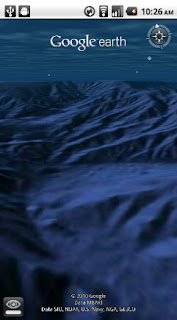
With the release of this feature, escape the hustle and bustle of life on land and discover the marine world using Google Earth on your mobile device. Now, you can check out the landscape and terrain in Monterery Bay Canyon, which is larger than the Grand Canyon, by zooming in on Google Earth below the ocean surface just off the coast. Once underwater, we can use the “look around” button to tilt the view and see the extent of this great undersea canyon.

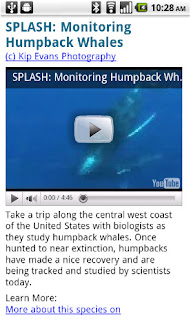
The latest version of Google Earth for Android also introduces the “Explore the Ocean” layer, which features hundreds of photos and videos from more than 100 contributors who are excited to share their stories of sea. Plan your next vacation during your daily commute by clicking on any of the little blue icons. The gold highlighted icons represent content from the Mission Blue Hope Spot initiative.


For those of you running Android 2.2, there are some more treats in store. Google Earth now supports Flash in balloons, so if you have the Flash player installed on your mobile device, you can watch videos right in the balloon. We’ve also made the program easier to navigate; for most devices, you can now use two fingers to “look around” and change your viewpoint, as an alternate to using the on-screen button. This makes it even easier to tilt your view to see mountainous landscapes or underwater canyons. Rotating your view with a simple twist of your fingers is now available on more devices as well.

Google Earth for Android 1.1 is available in Android Market today for most Android devices running version 2.1 or later. Explore the ocean anywhere.
qrcode

Posted by Jenifer Austin Foulkes, Product Manager
Read More..

Saturday, March 8, 2014

Translate the real world with Google Goggles

Traveling to another country can be an amazing experience. The opportunity to immerse yourself in a different culture can give you a new perspective. However, it can be hard to fully enjoy the experience if you do not understand the local language. For example, ordering food from a menu you can not read can be an adventure. Today we are introducing a new feature of Google Goggles that will prove useful to travelers and monoglots everywhere: Goggles translation.

Here’s how it works:
  • Point your phone at a word or phrase. Use the region of interest button to draw a box around specific words
  • Press the shutter button
  • If Goggles recognizes the text, it will give you the option to translate
  • Press the translate button to select the source and destination languages.


Google Goggles in action (click images to see large version)


The first Goggles translation prototype was unveiled earlier this year at the Mobile World Congress in Barcelona and could only recognize German text. Today Goggles can read English, French, Italian, German and Spanish and can translate to many more languages. We are hard at work extending our recognition capabilities to other Latin-based languages. Our goal is to eventually read non-Latin languages (such as Chinese, Hindi and Arabic) as well.

Every new release of Google Goggles contains at least one new feature and a large number of improvements to our existing functionality. In addition to translation, Goggles v1.1 features improved barcode recognition, a larger corpus of artwork, recognition of many more products and logos, an improved user interface, and the ability to initiate visual searches using images in your phone’s photo gallery.

Computer vision is a hard problem. While we are excited about Goggles v1.1, we know that there are many images that we cannot yet recognize. The Google Goggles team is working on solving the technical challenges required to make computers see. We hope you are as excited as we are about the possibilities of visual search.

Google Goggles v1.1 is available on devices running Android 1.6 and higher. To download, please scan the QR code below or go to the Android Market app on your phone and search for “Google Goggles”. See our help center for more information.


Read More..